
Every Man Needs a Prostate Plan
Please note: none of your personal information will be stored or tracked as you navigate to information that is appropriate to where you are in your prostate journey. If you have questions or require additional information, feel free to contact us.
Newly Diagnosed
A new diagnosis of cancer is always concerning. Prostate cancer aggressiveness can vary wildly, so it is most important to quickly understand what markers give insight to the likely aggressiveness of your disease. The National Comprehensive Cancer Network (NCCN) provides “gold standard” guidance for doing this via their patient guide. The Prostate Health Education Network (PHEN) PHENpath.com provides a simple presentation for understanding your cancer risk level.
The North Carolina Men’s Health Drive: Prostate Cancer Warriors Information Arsenal provides a quick field guide for gathering the information you need, translating that toward which treatment options you might want to consider, and shortcuts to the PHENpath page(s) that are most likely to benefit you.
This will help narrow down which treatment options professionals and researchers suggest you might consider.
Once you have a good understanding of what your personal situation is (your prognosis), find or assemble your multidisciplinary team to consult with about your options. Your team should include your primary care doctor, urologist, oncologists, and other medical professionals. Many hospitals/universities have multidisciplinary clinics for newly diagnosed patients that can provide balanced multidisciplinary care and information for patients making initial treatment decisions. Most accredited hospitals offer this service – be sure to ask for it!
You’re more likely to have the results you hope for with a balance of considering best available research evidence, the clinical expertise of your medical team, and your own personal preferences. Make sure you understand what side-effects you might anticipate while considering treatment options, and possible “pre-hab” opportunities.
For more information such as details about specific treatment options, visit the American Cancer Society (ACS) and the Prostate Cancer Foundation (PCF).
With 3.1 million survivors living with prostate cancer in the United States alone, men need to know how important it is to personally understand if their cancer needs treatment. If their cancer does need treatment, it’s important to know what side-effects come with each treatment choice, and what options are available for recovering function after treatment. Spare parts is a play on words. It can mean spare as in to save things like erectile function and continence, the loss of one or both being common side-effects from treating prostate cancer with surgery or radiation. It can also refer to “spare parts” as in replacement parts, or options for recovering from these side-effects if, in fact, treatment is necessary.
Patient Centered Outcomes Research Institute (PCORI) Evidence Updates: Prostate Cancer Treatments and Quality of Life (QOL)
- For patients (pdf)
- For medical professionals (pdf)
Tools for Talking to your Urologist about Symptoms and Side-Effects Associated with Prostate Cancer:
Options to Consider: Continence
Kegel Exercises and Biofeedback Therapy
Pelvic Floor Physical Therapy (may help with other side-effects)
Absorbent Products
Penile Clamps
Penile Catheters
Bulking Agents
Surgical Options
-Male Sling
-Artificial Urinary Sphincter
Options to Consider: Sexual Function
Oral Prescriptions
Vacuum Erectile Device (VED)
Intravenous Injection Therapy
Suppository
Penile Implant
When Prostate Cancer Returns, Grows, or Spreads
The following shortcuts will bring you to the Prostate Health Education Network (PHEN) PHENpath.com for a simple outline of common treatments for advanced or advancing disease.
When confronted with a challenging diagnosis, considering clinical trials is often a good idea.
Options when additional treatment is needed for:
- Biochemical recurrence (after surgery)
- Biochemical progression (after radiation)
- Hormone sensitive/castration naive cancer
*Note: Talk to your doctor about surgical (orchiectomy) versus chemical castration. Both methods are effective in lowering testosterone levels, but they differ in their delivery, cost, and potential side-effects. - Non-hormone sensitive/castration resistant cancer
For more information such as details about specific treatment options and research, visit the American Cancer Society (ACS) and the Prostate Cancer Foundation (PCF).
Monitoring Treatment Success and/or Predicting Recurrence – A Lifelong Journey
Your doctor should monitor your PSA levels periodically, even if you had a zero (0.0 ng/mL) PSA after treatment. Depending on how long ago you were diagnosed, you may need a PSA blood test every few months or years. PSA doubling time — the time it takes for your PSA level to double — can help predict how aggressive cancer is and detect a biochemical recurrence. The faster the PSA level doubles, the more aggressive the cancer. Circulating Tumor Cells and Testosterone Levels can also be used to track disease. Imaging and some genetic tests can also be helpful.
Make sure you have a Survivorship Care Plan and consider adopting strategies for integrative care to improve and enhance your overall quality of life – and joining the Prostate Cancer Coalition of North Carolina support network!
For more information, visit the American Cancer Society (ACS) and the Prostate Cancer Foundation (PCF).
Every Man Needs a Prostate Plan®
- If you are having prostate problems, consider scheduling an appointment with a skilled and knowledgeable urologist to discuss a prostate specific antigen (PSA) blood test AND a digital rectal exam (DRE).
- An elevated PSA can be due to a growing prostate, a prostate infection, or prostate cancer. New tests and biomarkers can help get to the bottom of your prostate troubles.
- While less common, low PSA producing Cancers can be very deadly and can only be found by DRE and possibly imaging.
- Keep your primary care doctor in the loop. Trouble urinating or with erectile function can be signs or symptoms of diabetes and/or cardiovascular disease!
- If you have an elevated PSA or abnormal (suspicious) DRE, scroll down to learn more.
Rapid Access Pathway
Remote Second Opinions
Share these publications with your primary care doctor!
- Michael ZD, Kotamarti S, Arcot R, Morris K, Shah A, Anderson J, Armstrong AJ, Gupta RT, Patierno S, Barrett NJ, George DJ, Preminger GM, Moul JW, Oeffinger KC, Shah K, Polascik TJ; Initial Longitudinal Outcomes of Risk-Stratified Men in Their Forties Screened for Prostate Cancer Following Implementation of a Baseline Prostate-Specific Antigen. World J Mens Health. 2022 Aug 16. doi: 10.5534/wjmh.220068. Epub ahead of print. PMID: 36047079.
- Shah A, Polascik TJ, George DJ, Anderson J, Hyslop T, Ellis AM, Armstrong AJ, Ferrandino M, Preminger GM, Gupta RT, Lee WR, Barrett NJ, Ragsdale J, Mills C, Check DK, Aminsharifi A, Schulman A, Sze C, Tsivian E, Tay KJ, Patierno S, Oeffinger KC, Shah K. Implementation and Impact of a Risk-Stratified Prostate Cancer Screening Algorithm as a Clinical Decision Support Tool in a Primary Care Network. J Gen Intern Med. 2021 Jan;36(1):92-99. doi: 10.1007/s11606-020-06124-2. Epub 2020 Sep 1. PMID: 32875501; PMCID: PMC7858708.
- North Carolina Advisory Committee on Cancer Coordination and Control Prostate Cancer Screening Position Statement Prostate Cancer Risk Evaluation and Screening.
- Aminsharifi A, Schulman A, Anderson J, Fish L, Oeffinger K, Shah K, Sze C, Tay KJ, Tsivian E, Polascik TJ. Primary care perspective and implementation of a multidisciplinary, institutional prostate cancer screening algorithm embedded in the electronic health record. Urol Oncol. 2018 Nov;36(11):502.e1-502.e6. doi: 10.1016/j.urolonc.2018.07.016. Epub 2018 Aug 28. PMID: 30170982.
- Patel MP, Schulman A, Shah KP, Anderson JB, Polascik TJ. Engaging the primary care community to encourage appropriate prostate cancer screening. Therapeutic Advances in Urology. 2017;10(1):11-16. doi:10.1177/1756287217735799
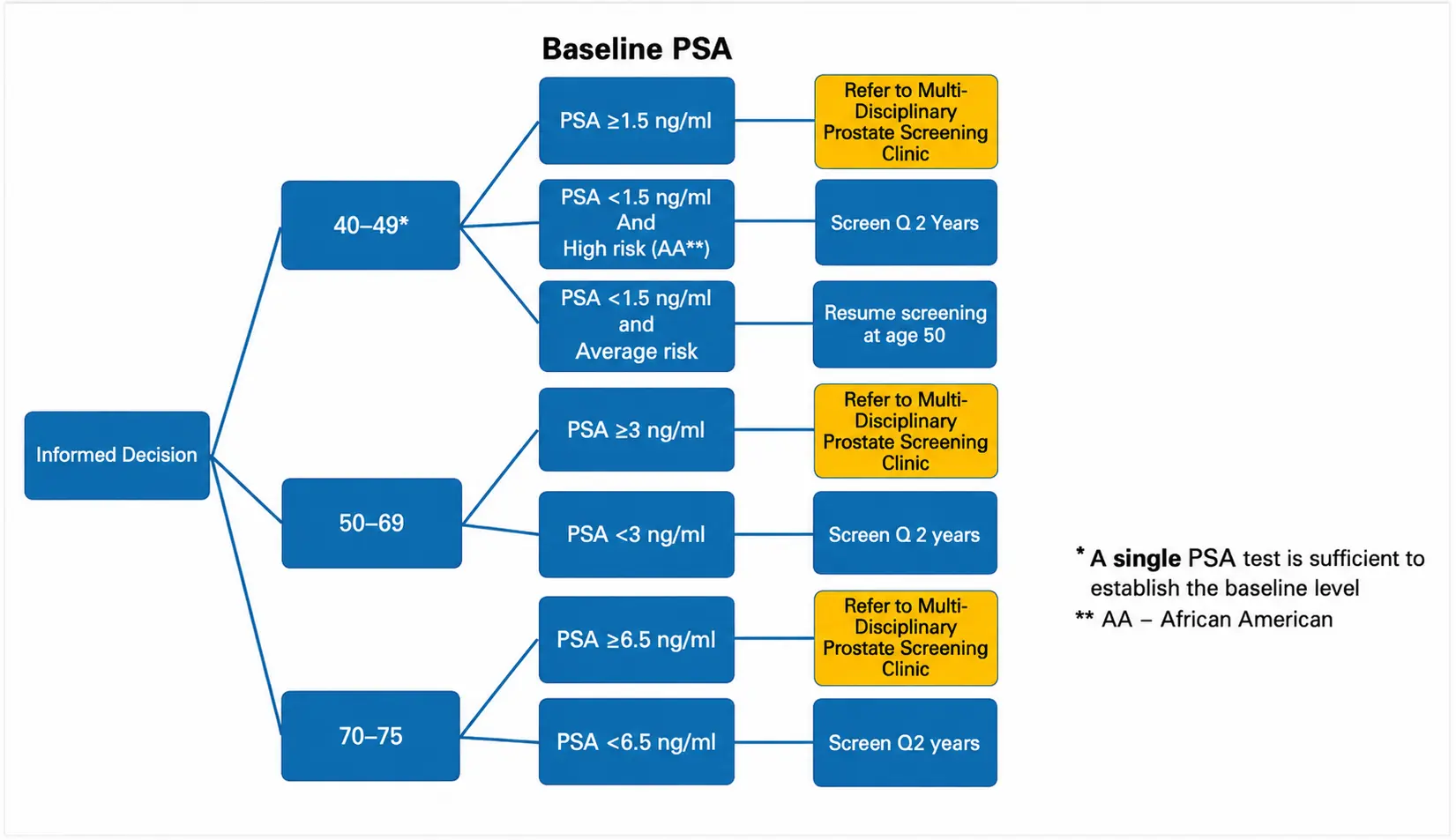
A baseline risk assessment for major causes of mortality in men can help proactively predict cardiovascular disease, cancer, diabetes, and more. Consider a baseline prostate screening at 40, when elevations are less likely to be caused by enlargement or other prostate conditions. Average prostate specific antigen (PSA) increases with age. Men with a higher than average baseline that is not due to certain conditions or activities are at the greatest risk for future development of aggressive prostate cancer. A low PSA number does not mean no cancer is present. While less common, low PSA producing prostate cancers can be very deadly and can only be found by DRE and possibly imaging.
Rapid Access Pathway
Join our mailing list
Contact Us
Mailing Address
Minnesota Prostate Cancer Coalition
P.O. Box 43211
Minneapolis, MN. 55443-0211
Jon Sellers
President
(612) 839-6209
Email

Our mission is to educate everyone about prostate cancer. We support prostate cancer survivors and their caregivers. Whether you are newly diagnosed or have advanced cancer, we're here for you.
HOME
NEWS
PROSTATE CANCER BASICS
NEWLY DIAGNOSED
ABOUT US
MORE INFO
TREATMENT OPTIONS
LEGAL